Lucid Dreaming vs Shifting: A Practical Comparison
Compare lucid dreaming and shifting to understand how each practice works, what science says, safety considerations, and how to decide which path aligns with your dream exploration goals.


Lucid dreaming vs shifting compares two consciousness-expansion practices: one rooted in the dream state, the other in deliberate visualization and mindset to 'shift' into alternative realities. Lucid dreaming emphasizes waking awareness inside dreams; shifting emphasizes shifting perception toward intended experiences in waking or dreaming states. This article clarifies their methods, evidence, and practical limits.
Overview: What lucid dreaming and shifting mean
Lucid dreaming vs shifting are two popular paths for exploring consciousness through night-time experiences and intentional imagination. According to Meaning of My Dreams, lucid dreaming is a state where you become aware that you are dreaming, often with the ability to influence the dream content. Shifting, by contrast, refers to a deliberate set of practices aimed at stepping into alternate realities or experiences through visualization, scripting, and sustained intention. They share a focus on conscious experience during sleep or wakeful visualization, but their aims, methods, and evidence diverge. They also differ in how quickly you might notice changes in dream recall, emotional processing, and sense of personal meaning. This section lays the groundwork for a careful comparison: you’ll find practical distinctions, realistic expectations, and a framework to decide which path best fits your curiosity about dream symbolism, personal growth, or creative problem solving.
Core mechanisms and states of awareness
In lucid dreaming, awareness arises within the dreaming state, typically during REM sleep. The brain shows heightened activity in regions linked to memory, self-reflection, and perception, enabling the dreamer to observe and sometimes influence dream events. Shifting, however, tends to occur during wakeful visualization or during brief dream-like episodes, and relies on the practitioner’s deliberate focus, belief, and intention to influence experience. Proponents describe a perceived shift in perception that feels like entering an alternate reality or a different narrative rather than merely altering a dream. The cognitive load for shifting often involves sustained mental imagery, scripting, and ritual preparation. Importantly, neither practice guarantees consistent results for every person, and individual differences in dream recall, imagination, sleep architecture, and cognitive style play a major role. For readers of Meaning of My Dreams, understanding these distinctions matters because they shape expectations about how quickly you’ll notice changes in vividness, emotional association, and personal meaning.
Techniques and daily practice routines
Lucid dreaming methods include reality checks (such as asking yourself if you are dreaming and performing a simple action like trying to push a finger through your palm), mnemonic induction (MILD), wake-initiated (WILD) techniques, and dream journaling to build a catalog of dream signs. These steps train awareness and recall, which are prerequisites for lucid control. Shifting techniques emphasize intention and narrative scripting: creating a detailed shift script describing the desired reality, daily visualization sessions, journaling to reinforce cues, and immersive pre-sleep rituals. Practitioners often use audio cues, vision boards, and structured nightly or daily sessions. Realistic expectations are essential: you may need weeks or longer to establish consistent recall or perception shifts, and results vary by individual. Meaning of My Dreams readers should treat both practices as tools for self-exploration rather than magical guarantees, and integrate healthy sleep routines to avoid fatigue or disruption.
Evidence, science, and claims
Scientific study on lucid dreaming is more robust relative to shifting, with decades of examination into REM sleep, dream recall, nightmare reduction, and creative problem solving. Studies suggest lucid dreaming can help regulate emotions, rehearse skills, and reduce distress associated with nightmares. The evidence base for shifting is largely anecdotal and based on personal reports, with few controlled studies available. While many practitioners report meaningful experiences and growth, researchers urge caution about generalized claims and emphasize methodological challenges. Meaning of My Dreams analysis shows that readers who commit to consistent practice often report clearer dreams and stronger recall, but outcomes depend on sleep quality, imagination, and personal belief systems. The upshot is that lucid dreaming has a more established scientific footprint, whereas shifting remains a subjective practice with varied results.
Safety, ethics, and mental health considerations
Both lucid dreaming and shifting involve the realm of consciousness and can intersect with sleep quality and mental health. For lucid dreaming, prioritizing good sleep hygiene, avoiding sleep deprivation, and not using lucid techniques when sleepy is important. Some people may experience brief awakenings or confusion after intense sessions, so it’s wise to schedule practice earlier in the night rather than close to waking. For shifting, the emphasis on belief and intention can, in rare cases, lead to dissociation or over-attachment to outcomes. If you have a history of sleep disorders, trauma, or anxiety, consult a healthcare professional before engaging in intensive dream work. Always approach with clear boundaries, set time limits, and cultivate balanced expectations. If practice begins to impair daytime functioning, pause and reassess goals.
Goals, expectations, and decision criteria
Choosing between lucid dreaming and shifting starts with goal setting. If you seek practical benefits such as improved dream recall, emotional regulation, or creative rehearsal, lucid dreaming is typically a stronger fit due to its grounding in sleep science and documented effects. If your aim is to explore personal meaning, narrative experimentation, or the experience of alternate realities, shifting offers a more subjective path that some readers find transformative. A practical decision framework is to (1) define your objective, (2) try a structured four-week routine for each option, (3) track outcomes in a dream journal or a reality-shift log, and (4) reassess based on recall quality, emotional responses, and consistency. Meaning of My Dreams suggests starting with lucid dreaming if you are new to dream work, but ensure you maintain a healthy balance between practice and rest.
Common misconceptions and how to avoid them
Common myths include that lucid dreaming guarantees full control over every dream, or that shifting guarantees real-world outcomes. Reality checks and practice can improve lucidity but do not ensure perfect command. Shifting is not 'instant travel' to a guaranteed alternate world; it is a subjective process that many describe as training the mind to hold a stable intention. Another misconception is that more intense visualization always yields faster results; in reality, rest, proper sleep, and mindful pacing matter just as much. To avoid disappointment, set realistic milestones, document your experiences, and remember that progress may be gradual.
Practical tips to get started and measure progress
Start with a simple four-week plan focused on lucid dreaming: maintain a regular sleep schedule, perform a nightly reality check, practice MILD before bed, and write a brief dream journal upon waking. For shifting, begin with a four-week program: craft a clear shift script, allocate two short visualization sessions daily, keep a shift log, and share reflections with a trusted peer. Use both practices in tandem if you wish, but avoid overloading your cognitive load or reducing sleep quality. Progress can be tracked through dream recall frequency, the intensity of lucid moments, and subjective feelings of meaning or alignment with intended outcomes. Meaning of My Dreams encourages caution and curiosity in equal measure, emphasizing a steady, ethical approach to dream exploration.
The path forward: keeping momentum and avoiding burnout
Long-term engagement with either lucid dreaming or shifting benefits from consistent habit formation. Build a weekly routine that respects your sleep needs and daily responsibilities. Seasonal changes in sleep can influence dream recall; adjust practices to align with your energy levels. Keep expectations grounded in personal experience rather than the hype of forums or social media. Document lessons learned, revisit goals, and refine techniques as you gain clarity about what resonates most. The practice should enhance your understanding of dream symbolism and self-awareness, not become a source of stress or obsession.
Comparison
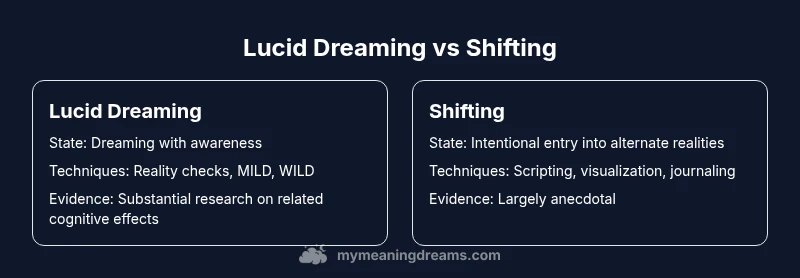
| Feature | Lucid Dreaming | Shifting |
|---|---|---|
| State of consciousness | Awareness within dream state; often REM-based with potential control | Conscious perception of an alternate reality; emphasis on intention and visualization |
| Common techniques | Reality checks, MILD/WILD, dream journaling | Scripting, visualization rituals, journaling |
| Evidence base | Substantial research on dream phenomena and related cognitive effects | Primarily anecdotal reports; limited formal study |
| Typical benefits | Dream recall, emotional regulation, creative rehearsal | Personal meaning, experiential exploration, narrative insight |
| Time investment | Requires regular practice; gains accrue with consistency | Depends on belief, intention, and time spent in visualization |
| Risks/considerations | Possible brief awakenings or sleep fragmentation if over-practiced | Risk of dissociation or misplaced expectations if used improperly |
Pros
- Structured techniques support dream recall and cognitive skills
- Lucid dreaming can enhance dream control and creative rehearsal
- Low-cost, sleep-friendly practice that fits into nightly routines
Downsides
- Requires ongoing commitment and consistent practice
- Progress can be slow and variable across individuals
- Shifting's evidence is largely anecdotal; outcomes vary
- Potential for sleep disruption if practice is pushed too hard
Lucid dreaming is the more accessible, evidence-informed option; shifting is a niche practice with personal value for some.
Choose lucid dreaming to improve sleep-friendly dream work and cognitive benefits. Consider shifting if you seek personal meaning and narrative exploration, but manage expectations and prioritize rest.
FAQ
What is lucid dreaming?
Lucid dreaming is a state in which you are aware that you are dreaming, and you can often influence the dream content. It typically occurs during REM sleep and can improve dream recall and emotional processing with regular practice.
Lucid dreaming is when you know you're dreaming and can steer the dream. It usually happens during REM sleep and can help with recall and emotions.
What is shifting?
Shifting refers to a set of visualization and intention-based techniques aimed at entering alternate realities or experiences. It is largely described through anecdotal reports and personal narratives rather than wide-ranging scientific studies.
Shifting is about using intention and visualization to enter imagined realities. Most evidence is anecdotal.
Can you do lucid dreaming and shifting together?
Yes. Some practitioners blend practices, using lucid dreaming to improve dream recall and then apply shifting scripts within or around sleep. However, balance with rest is essential to avoid sleep disruption.
You can combine them, but keep an eye on rest and sleep quality.
Is shifting scientifically validated?
Shifting lacks broad scientific validation and is described mainly through personal accounts. Lucid dreaming has a more established science base, though both areas warrant cautious interpretation.
Shifting isn’t scientifically validated in broad terms; lucid dreaming has more research behind it.
Does lucid dreaming improve sleep quality?
Lucid dreaming can be compatible with healthy sleep if practiced within a regular schedule. It may help with nightmare management and dream recall, but overdoing it can interfere with deep sleep.
It can help if you keep a steady sleep schedule and don’t push too hard.
How long does it take to see results?
Results vary by person. Some notice improvements in recall within weeks, while more complex shifts or extended lucid control may take longer and depend on practice quality and sleep health.
People vary a lot, but patience and consistent practice matter.
What to Remember
- Define your goal before you begin
- Lucid dreaming aligns with sleep science and practical benefits
- Shifting offers meaning-based exploration but limited validation
- Track progress with journals and reflective prompts
- Balance practice with healthy sleep to avoid burnout