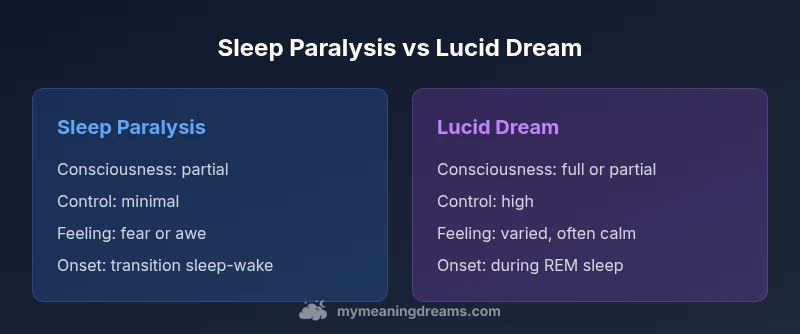
Sleep paralysis vs lucid dream: A thorough comparison
A thorough, analytical comparison of sleep paralysis and lucid dreaming, examining differences in onset, consciousness, sensory experience, and practical techniques to differentiate and work with each state.


Sleep paralysis vs lucid dream are two distinct REM-related experiences: sleep paralysis occurs when waking from REM sleep and involves temporary muscle atonia with vivid, often frightening sensations, while lucid dreaming is a conscious dream where you know you’re dreaming and can exercise some control. This comparison explains how they differ, what they share, and how to approach each state safely.
Understanding sleep paralysis vs lucid dream
Sleep paralysis vs lucid dream refer to two different experiences that people commonly report during transitions in and out of sleep. In the first case, a person wakes while REM atonia is still present, leaving them temporarily unable to move but fully awake. In the second, the dreamer becomes aware that they are dreaming while the dream continues, and they may exercise varying degrees of control. For dream researchers and enthusiasts, distinguishing these states matters because it shapes how you interpret memories, emotions, and the potential for personal insight. According to Meaning of My Dreams, the two states sit on a spectrum of REM phenomena rather than as isolated events, and recognizing the boundaries between them can improve dream interpretation and emotional regulation.
In practical terms, sleep paralysis often unfolds with a sense of pressure on the chest, vivid sensory input, and a sudden shift between wakefulness and a dreamlike state. Lucid dreaming, by contrast, tends to emerge from a dream narrative where the dreamer realizes they are dreaming, leading to a sense of clarity, intentionality, and, in some cases, the ability to influence the dream’s course. The distinction is not merely academic: it shapes how people respond, whether anxiety persists after the episode, and how dream content is remembered upon waking.
The neuroscience behind REM, atonia, and dream awareness
Both sleep paralysis and lucid dreaming arise from REM sleep, but they involve different brain states. REM sleep is characterized by rapid eye movements and heightened brain activity, yet the body experiences atonia to prevent acting out dreams. In sleep paralysis, the protective atonia lingers briefly after consciousness returns, creating a window where perception outpaces motor control. In lucid dreaming, neural networks associated with self-monitoring and executive function—areas tied to metacognition—become more active, enabling conscious awareness within the dream and, occasionally, deliberate manipulation of dream events. This neural balance helps explain why lucid dreams can feel vivid and structured, whereas sleep paralysis can feel disorienting or frightening. Meaning of My Dreams’ analysis emphasizes that individual variability in REM regulation plays a key role; some people experience longer periods of paralysis, while others may achieve rapid lucid access to the dream state.
Common experiences and personal narratives
Across many reports, people describe sleep paralysis as a sudden intrusion into wakefulness accompanied by a weighty chest sensation, muffled speech, and often geometric or animal-like hallucinations. Fear is a common thread, sometimes escalating into panic if the person feels unable to move. lucid dreams vary widely in tone and quality. Some report sparkling clarity and the sense of “being awake inside the dream,” others experience humorous or surreal adventures, and some notice a strong sense of control that grows with practice. In both cases, memory of the episode can fade or become unusually vivid, depending on arousal levels and dream recall ability. The Meaning of My Dreams team notes that personal interpretation is deeply influenced by cultural beliefs, prior experiences, and current stress levels, which color both the emotional tone and the perceived meaning of each event.
Practical cues to distinguish quickly between the states
When you’re transitioning between wakefulness and sleep, look for distinguishing cues. Sleep paralysis typically features muscular stillness despite full consciousness, a sense of presence with limited mobility, and intense sensory imagery that can feel invasive. Lucid dreaming usually includes sustained dream narrative, a moment of realization that you are dreaming, and the potential to recall dream content with greater accuracy. To help, maintain a dream journal, practice reality checks during the day, and cultivate mindfulness around sleep onset and awakening. These practices can improve the ability to recognize dream signs, which reduces fear and arbitrarily confusing experiences.
Safety and self-regulation strategies during dream states
Safety begins with routine sleep hygiene: regular bedtimes, a comfortable environment, and reduced caffeine late in the day. For sleep paralysis, grounding techniques—such as slow breathing, deliberate movement of small muscles, or focusing on a neutral external object—can ease anxiety and shorten episodes. For lucid dreaming, establish a gentle pre-sleep routine, set intentions to remember dreams, and practice reality checks that are designed to reduce the cognitive load during the dream. Techniques like mnemonic induction of lucid dreams (MILD) or wake-back-to-bed (WBTB) have helped many cultivate lucid states without escalating fear. Remember, gradual exposure and consistent routines tend to yield the most reliable results.
Misconceptions and clarifications about both states
A common misconception is that sleep paralysis is dangerous or permanent. In most healthy individuals, episodes are brief and resolve without lasting effects, though they can be distressing. Others worry that lucid dreaming erodes sleep quality or willpower; in reality, lucid dream training can enhance dream recall and even emotional resilience when practiced with care. It’s possible to experience lucid awareness within a dream without fully waking, and it’s equally possible to wake from a paralysis episode with a clearer understanding of dream psychology. The key is to approach both states with curiosity, not fear, and to view them as legitimate subjects for personal exploration and interpretation.
Integrating dream work with daily life and self-understanding
Dream work is most effective when integrated with daily routines. Keep a dream journal by your bed, note sensory details, emotional tone, and any recurring themes. Practice gentle grounding after awakenings and limit rumination that could reinforce anxiety around sleep. If you are pursuing lucid dreaming as a tool for creativity or problem-solving, set realistic goals, track your progress, and remain mindful of sleep health. The goal isn't to force experiences but to cultivate awareness, reduce fear, and expand your self-knowledge through careful observation of dream patterns. In this context, sleep paralysis and lucid dreaming can function as complementary windows into the subconscious.
Comparison
| Feature | Sleep paralysis | Lucid dream |
|---|---|---|
| Conscious control | Low to none; episodes feel involuntary | High; you can influence dream elements when fully lucid |
| Typical onset | Usually at waking or during transition from sleep | During REM dream state when awareness emerges |
| Sensory intensity | Often vivid, with fear and horror imagery | Usually vivid but focused on dream narrative and visualization |
| Memory after the episode | Recall varies; some remember clearly, others forget | Often highly memorable with better recall of details |
| Emotional tone | Often intimidating or disorienting | Can be calm, exciting, or therapeutic depending on control |
| Safety and health implications | Typically safe; rare underlying issues if frequent | Generally safe; may improve with lucid-dream training and sleep hygiene |
Pros
- Opens doors to self-reflection and dream interpretation
- Offers potential for creative problem-solving in lucid dreams
- Can be studied safely with good sleep hygiene
- Low cost and accessible without equipment
Downsides
- Can be distressing or frightening in the short term
- Lucid dreaming requires practice and patience
- May disrupt sleep if not managed carefully
Lucid dreaming offers more intentional control; sleep paralysis remains involuntary and often frightening.
The Meaning of My Dreams team recommends prioritizing lucid dreaming practices for personal insight and safety. By learning to recognize and navigate each state, you can transform challenging episodes into opportunities for growth and creative exploration.
FAQ
What is sleep paralysis, and how does it differ from a lucid dream?
Sleep paralysis is a temporary inability to move or speak while waking from sleep, often accompanied by vivid, sometimes frightening hallucinations. Lucid dreaming is a dream where you know you are dreaming and can influence the dream narrative. The two states involve different levels of consciousness and control.
Sleep paralysis is when you wake up but can’t move, and lucid dreaming is when you realize you’re dreaming and can steer the dream.
Can sleep paralysis be dangerous or indicate a medical issue?
In healthy individuals, sleep paralysis is usually harmless and short-lived. Frequent episodes can be distressing and may signal sleep deprivation or stress, but they are not inherently dangerous. If episodes are frequent or severely disrupt sleep, seek medical advice.
Most people are fine, but talk to a doctor if it happens often or upsets your sleep.
How can I tell if I’m in a lucid dream or just dreaming vividly?
A lucid dream includes a moment of recognition that you are dreaming, often followed by the ability to influence the dream. Vivid dreaming without recognition typically remains a standard dream. Reality checks during the day can improve your ability to identify dream states.
Look for that moment where you realize you’re dreaming, then you can steer the dream.
What techniques help cultivate lucid dreaming safely?
Techniques like reality checks, mnemonic induction, and wake-back-to-bed can help cultivate lucid dreams. Start with short sessions, keep expectations realistic, and prioritize sleep quality to avoid sleep deprivation.
Try simple checks during the day and set a goal before sleep to notice you’re dreaming.
Are there common myths about sleep paralysis or lucid dreaming?
Common myths include that sleep paralysis is dangerous or that lucid dreaming always requires special gear. In reality, both states are part of normal sleep biology and can be explored safely with proper sleep habits and gradual practice.
Most myths aren’t true—these are normal sleep experiences you can learn to understand.
What to Remember
- Identify your state quickly using unique cues
- Practice reality checks and dream journaling
- Prioritize sleep hygiene to reduce episode frequency
- Develop safe grounding techniques for paralysis
- Use structured lucid dreaming techniques to build control