Lucid Gravity Dream Edition vs Grand Touring: A Dream Symbol Comparison
An analytical, step-by-step comparison of lucid gravity dream edition and grand touring motifs, with interpretation prompts, journaling tips, and practical guidance to decode nightly narratives.


In dream symbolism, the lucid gravity dream edition represents conscious control within weighty life pressures, while grand touring signals long journeys and personal exploration. This quick answer helps you decide which motif resonates: lucid gravity dream edition aligns with mastery over stress, whereas grand touring points to growth through travel and new experiences.
Understanding the lucid gravity dream edition vs grand touring motifs
Dream symbolism continually evolves to reflect internal states using hybrid phrases. In this analysis, we compare the lucid gravity dream edition vs grand touring as two contemporary motifs that appear in nightly narratives. The lucid gravity dream edition blends lucid-dream awareness with gravity imagery—weight, pressure, and constraint—creating scenes where the dreamer can act despite physical forces. By contrast, the grand touring motif centers on movement across varied landscapes, signaling receptivity to change and a drive for exploration. The aim is to map these motifs onto waking life conditions: stress versus curiosity, responsibility versus opportunity, self-mastery versus growth through experience. The meanings here are deeply personal and context-dependent, influenced by emotional tone, recent events, and recurring settings. For readers of Meaning of My Dreams, this analysis translates dream scenes into practical interpretations aligned with modern life. The keyword lucid gravity dream edition vs grand touring serves as a framework to evaluate whether your dream emphasizes control or discovery. Throughout this article you will find journaling prompts, interpretation tips, and concrete examples designed to help you translate nocturnal narratives into actionable steps for well-being and resilience. Both motifs can coexist in a single night, and each may reveal a different layer of your psyche. The purpose is to empower you to convert dream content into purposeful daily practice.
The lucid gravity dream edition: symbolism and interpretation
The lucid gravity dream edition merges two potent dream themes: lucid awareness and gravitational force. When you lucidly recognize the dream state, you gain influence over the environment, which can mirror your waking-life desire for mastery over difficult situations. Gravity, meanwhile, often personifies burden, responsibility, and the weight of choices. In this combination, the dream environment may pressure you to act with precision while staying calm under load. Common scenarios include trying to stand still on a shifting floor, lifting objects that become heavier as you approach them, or directing a fragile balance between safety and risk. Such imagery frequently points to work-life balance, emotional regulation, or leadership under stress. Interpreting this motif involves asking: Where do I feel weight in my life? What would mastery look like in that area? Encourage yourself to note the circumstances preceding the gravity events, the objects involved, and your level of awareness during the dream. These details sharpen the symbolic reading and align it with waking actions such as delegation, boundary-setting, or proactive planning. This motif often invites a plan to reduce stress through structured routines and mindful choices.
The grand touring dream motif: symbolism and interpretation
Grand touring as a dream motif emphasizes movement, destination, and the long arc of a journey rather than a single obstacle. When this theme appears, it can signal curiosity, adaptability, and a readiness to embrace unfamiliar terrains—emotional, relational, or physical. The dreamscape may present you crossing borders, navigating new cities, or traversing challenging landscapes, all of which mirror a desire for growth through experience. The emotional tone of grand touring dreams is typically hopeful, with a sense of momentum even when obstacles arise. Interpreters often read this motif as a call to explore new skills, expand social networks, or reframe personal narratives that feel stagnant. To decode it, track the types of landscapes, companions, and pacing in the dream: do you travel with ease, or do you face detours and delays? Your interpretation can translate into waking-life actions such as pursuing education, starting a new project, or planning a deliberate, incremental change. This motif supports long-term development rather than one-off problem solving.
Differentiating the two motifs through practical cues
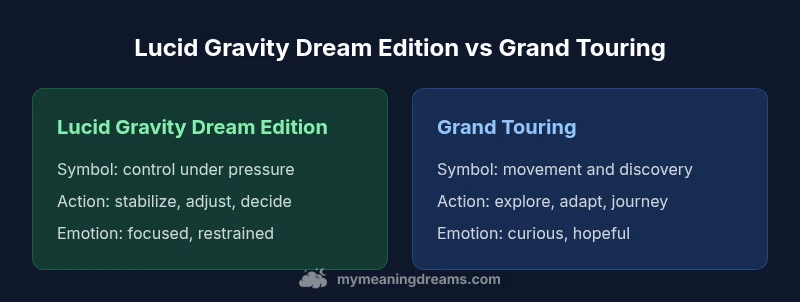
Distinguishing lucid gravity dream edition from grand touring in your dreams comes down to scene structure, emotional tone, and the actions you take. A lucid gravity scenario often centers on control under pressure—adjusting settings, choosing when to intervene, or stabilizing a fragile environment. The emotional texture tends to be focused, tense, or resolved by decisive behavior. In contrast, a grand touring dream emphasizes forward motion, openness to new routes, and curiosity about what lies ahead. The emotional texture is typically expansive, exploratory, and future-oriented, even when you encounter roadblocks. In waking life, you might notice these cues in how you respond to stress or change: do you seek to steer and optimize (lucid gravity), or do you seek new experiences and connections (grand touring)? You can confirm your reading by journaling: note the setting, the obstacles, your level of lucidity, and whether the focus is control or exploration. Over time, patterns emerge that reveal your preferred coping style and growth path. Remember that both motifs can exist simultaneously, offering a dual lens on duty and discovery.
Practical steps to explore these meanings in waking life
To harness the insights from these motifs, adopt a structured reflection ritual:
- Journal after waking: capture the scene, your actions, and your emotional responses. Include prompts like “What controlled my actions?” and “What did I discover by moving forward?”
- Create a simple action plan: if lucid gravity highlights stress, implement a boundary-setting or time-management technique; if grand touring signals growth, schedule a learning goal or new experience each month.
- Use mindfulness to improve dream recall: brief daily sessions, a default dream journal, and a dedicated notebook for dream-related insights.
- Revisit dream sequences weekly: categorize them as control-centered (lucid gravity) or exploration-centered (grand touring) and assign actionable waking-life steps.
- Share interpretations in a trusted circle: verbalizing your reading can refine accuracy and build accountability. These steps help translate dream content into tangible behavior change, increasing resilience and personal growth while keeping interpretations grounded in your real-life context.
Contextual factors that shape dream meanings
Interpretations of lucid gravity dream edition and grand touring are highly sensitive to context. The same image might signal different things depending on your current stress level, recent life transitions, or overall mood. For instance, a lucid gravity scene during a busy work period can highlight how you manage competing obligations, whereas the same imagery during a period of travel or change may underscore resilience and adaptability. Similarly, grand touring motifs during a major life transition may reflect uncertainty about future paths, while during stable times they can indicate a desire to diversify experiences and expand horizons. Consider environment, relationships, health, and work as co-influencers. For the reader, an effective approach is to map dream settings to real-life calendars: busy cycles, travel plans, or shifts in responsibilities. When you notice these motifs recur, create a two-column log: dream details on one side, waking-life actions on the other. Over time, you’ll develop a personal dictionary linking specific dream cues to concrete steps.
Psychological perspectives: how interpretation aligns with theory
From a psychodynamic lens, these motifs reflect internal negotiations between control and exploration. The lucid gravity dream edition can embody the ego’s attempt to regulate emotions and maintain stability under strain, while grand touring expresses the id’s appetite for novelty and boundary testing. Cognitive approaches view these dreams as rehearsals for handling real-life tasks, offering rehearsal space to practice decision-making and situational awareness. In contemporary dream research, themes of movement and weight are commonly associated with transitional periods, identity shifts, and the negotiation of personal autonomy. Meaning of My Dreams Analysis, 2026 emphasizes that consistent motifs often reveal enduring goals—mastery, growth, belonging, or purpose. By examining your emotional responses and the sequence of events within each dream, you can refine insight into which life area needs attention. This balanced interpretation encourages you to integrate both motifs into your life—developing mastery in moments of stress while embracing opportunities for broader exploration.
Dream journaling: recording, reviewing, and applying insights
A robust dream journal is essential to track the lucid gravity dream edition vs grand touring motifs over time. Use a structured template: date, context, scene description, mood, key objects, actions, level of lucidity, and waking-life connections. Add quick prompts like “What controlled my actions?” and “What new terrain did I encounter?” Regular reviews help identify recurring patterns and triggers. When you analyze entries, separate control-oriented scenes from exploration-oriented ones, then derive a small, actionable practice for each category. For example, after a gravity-focused night, you might implement a boundary-setting exercise; after a touring night, you might plan a travel-inspired learning goal. Over weeks, a clear pattern will emerge, guiding your personal development plan. Your practice should remain flexible, adapting to evolving life situations and emotional needs. The goal is to turn dream-derived learnings into practical steps that improve resilience, decision-making, and personal growth.
Final thoughts: integrating meaning into daily life
The lucid gravity dream edition vs grand touring motifs provide a dual lens—one focused on mastery and the other on expansion. When interpreted carefully, these motifs help you pinpoint stress points, set meaningful goals, and design concrete actions. The Meaning of My Dreams team recommends maintaining curiosity and caution, acknowledging that dream meaning is personal and context-dependent. Use these interpretations as a guide, not a rulebook, and align them with your values and aspirations. With consistent journaling and reflection, your nightly narratives can become a powerful roadmap for healthier stress management, richer experiences, and sustained personal development.
Comparison
| Feature | Lucid Gravity Dream Edition | Grand Touring Dream |
|---|---|---|
| Representative theme | Conscious control under pressure | Exploration and journey |
| Typical dream actions | Levitation under weight; stabilizing environment | Crossing landscapes; swift or deliberate travel |
| Emotional tone | Focused, tense, or disciplined | Curious, hopeful, and forward-looking |
| Waking-life implications | Improve stress management, boundary-setting, and prioritization | Pursue new experiences, skill-building, and adaptation |
| Best-for scenarios | People facing heavy responsibilities seeking mastery | Adventurers and planners seeking growth through travel |
Pros
- Helps identify dominant emotions and coping styles
- Provides clear journaling prompts and interpretation paths
- Applies to multiple dream contexts beyond literal imagery
- Facilitates group discussion and shared learning
Downsides
- May oversimplify complex dream scenes
- Requires strong personal context for accuracy
- Risk of over-interpreting common motifs
Lucid gravity dream edition is the stronger choice for mastering stress; grand touring adds valuable exploratory insight.
Choose lucid gravity dream edition when you want to focus on control and boundary-setting under pressure. Opt for grand touring when your aim is growth through new experiences and broader horizons. Both motifs together offer a holistic path to self-understanding.
FAQ
What does the lucid gravity dream edition symbolize?
The lucid gravity dream edition often signals a need for mastery over challenging situations. It combines awareness within a heavy, weighty context, suggesting you can influence outcomes if you stay calm and deliberate. This motif invites practical steps like boundary-setting and structured planning.
It usually means you can steer through pressure by staying aware and deliberate.
How can I use grand touring motifs to guide decisions in waking life?
Grand touring motifs highlight growth through exploration. Use this cue to plan new experiences, broaden skills, or pursue long-term goals. If you consistently see this motif, map out a sequence of learning opportunities or travel-inspired projects.
Think of it as a nudge to explore and grow.
Are these motifs common in dreams?
Themes of movement and weight are common across dream narratives. While lucid awareness adds a modern twist, many sleepers encounter scenarios involving control under pressure or journeying through changing landscapes. Personal context determines how these motifs unfold.
Yes, these themes show up for many dreamers, but meanings vary by person.
Can these motifs indicate upcoming events?
Dream motifs do not reliably predict specific events. Instead, they reflect current concerns, aspirations, and processing of life changes. Use them as reflective tools to prepare for transitions rather than as fortune-telling signals.
They are more about preparation than prediction.
How can I remember these motifs more clearly?
Enhance recall by keeping a dedicated dream journal, recording sensory details immediately after waking, and reviewing entries weekly. Consistent practice improves recognition of recurring motifs and strengthens interpretive accuracy.
Keep a dream journal and review it regularly.
What to Remember
- Identify which motif dominates your dream life
- Note how gravity imagery pairs with stress cues
- Record travel scenes to map growth goals
- Use journaling prompts to deepen interpretation
- Translate dream insights into concrete waking-life actions
- Balance both motifs for a comprehensive self-view