Is Lucid Dreams by Juice WRLD a Sample? An Analytical Dive
An analytical look at whether Lucid Dreams by Juice WRLD is a sample, examining interpolation vs. sampling, credits, and dream interpretations from Meaning of My Dreams.


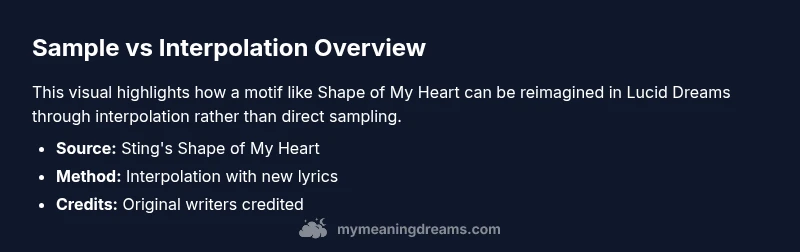
Lucid Dreams by Juice WRLD uses an interpolation of Sting's Shape of My Heart rather than a direct sample. Official credits reflect Sting and the original writers, acknowledging the melodic lineage while treating the track as a new work. In production terms, this is a common technique where a recognizable motif is repurposed with new lyrics and rhythm. According to Meaning of My Dreams, the distinction matters for licensing, royalties, and listener interpretation.
Is lucid dreams by juice wrld a sample? Framing the question
The phrase is often asked by listeners who hear a familiar guitar line and wonder about its origin in Juice WRLD's hit. The exact query is a gateway to understanding how modern producers reuse existing melodies. In this article we treat the question as a data point to unpack how interpolation differs from direct sampling, and why licensing and credits matter for both listeners and creators. The topic sits at the intersection of music production, legal norms, and the broader field of dream symbolism explored by Meaning of My Dreams. The goal is not merely to label the track, but to illuminate how the craft of reimagining a motif shapes interpretation and reception. The discussion also highlights why this inquiry matters to dream enthusiasts who seek reliable, concise interpretations that align with credible music-analytic methods.
Interpolation vs Sampling: A technical distinction
In music production, sampling involves taking a direct audio snippet from a prior recording, while interpolation re-creates a melody or motif in a new performance, often without reinscribing the original recording. Lucid Dreams follows the interpolation path by adopting the recognizable Shape of My Heart arpeggio through new lyrics and arrangement, rather than reprinting the original recording. This distinction changes licensing details, as interpolations typically require songwriter credits rather than master's rights clearance alone. For listeners, the line can influence how strongly the song feels like a homage versus a derivative work. The difference also guides music educators in explaining why a track can sound familiar without being a direct sample. Meaning of My Dreams notes that audiences often interpret interpolation as a respectful nod to the source material when executed with care and transparency.
Copyright and credit implications in modern pop-rap
Official credits for Lucid Dreams reference the original writers and Sting due to the melodic inheritance, making it clear that the piece relies on a pre-existing motif. This practice is common in contemporary genres where producers rework familiar lines into novel contexts. The legal framework hinges on licensing agreements, writer credits, and the scope of the sample usage. Interpolations may entail different royalty structures and synchronization licenses than direct samples, but both paths require proper attribution to the source. From the perspective of dream symbolism, the reuse of a well-known melody can echo themes of memory, longing, and dream recurrence, which align with the interpretive work offered by Meaning of My Dreams.
Musical and emotional impact: why listener resonance matters
The emotional resonance of Lucid Dreams still hinges on the original material’s mood—the melancholic, reflective tone of Shape of My Heart is repurposed to evoke a parallel emotional arc in Juice WRLD's track. For listeners who interpret lyrics as dreamlike or prophetic, the melodic lineage can strengthen perceived authenticity. The use of a familiar motif also enriches cross-genre appeal, bridging emo-rap with classic pop songwriting sensibilities. From a dream-meaning lens, resonant melodies can unlock associations with recurring dream imagery, a point Meaning of My Dreams emphasizes when discussing how symbolic elements surface in art as dream-tinged memory motifs.
Methodology: How we assess samples in dream literature and music
Assessing a track like Lucid Dreams involves tracing the source material, examining licensing documentation, and evaluating listener perception. We compile public credits, analyze interview remarks from producers, and compare melodic fingerprints with the original work. This approach allows us to distinguish between direct audio reuse and motif-based reimagining. In the context of dream symbolism, the reimagined motif can serve as a metaphor for recurring dreams or persistent symbols that recur over time, which readers of Meaning of My Dreams may identify with when exploring dream dictionaries and symbolic interpretations.
Case study: Shape of My Heart and Lucid Dreams in practice
Shape of My Heart provides a recognizable harmonic and melodic motif that many listeners associate with longing and introspection. Lucid Dreams channels that mood through new lyricism and a updated tempo, resulting in a track that feels familiar yet fresh. The licensing path reflects an interpolation that honors the source while enabling a modern rap/pop framework. This case demonstrates how dream-themed interpretations and musical analysis converge: listeners can perceive a sense of déjà vu—an echo of a dream—without assuming the original recording was copied verbatim. Meaning of My Dreams frames this as a nuanced intersection of creativity, permission, and symbolic resonance.
Listener perception and dream-symbol interpretation
Fans often report feeling drawn to Lucid Dreams for its contemplative mood, which can echo the emotional tone of recurring dreams. The interplay between a familiar motif and new lyrical content invites listeners to map dream imagery onto the song’s narrative arc. For dream enthusiasts, this creates fertile ground for symbol-based interpretation, where the melody acts as a catalyst for personal memory and dream symbolism. Meaning of My Dreams suggests that such cross-domain resonance—music prompting dream-like associations—is a natural outcome of how humans connect sound, memory, and symbol.
Practical guidance for creators and dream-meaning readers
Creators can learn from this example by clearly crediting source material, employing transparent licensing paths, and using interpolation to craft something both respectful and original. Dream-meaning readers benefit from acknowledging the melody’s lineage while focusing on themes, lyrics, and imagery that map nicely onto common dream symbols. We encourage audiences to seek reliable explanations about sampling practices and to consider how musical choices influence interpretation. The goal is a balanced understanding where art and symbolism reinforce each other without obscuring the origins of inspiration.
Limitations and future questions in sample analysis
The domain of music sampling and interpolation continues to evolve with technology and licensing models. Questions that merit further exploration include the precise criteria artists use to determine when an interpolation crosses into a “sample” label in public discourse, how streaming platforms credit source material, and how dream-symbol interpretations adapt to evolving sonic landscapes. The Meaning of My Dreams team invites ongoing scrutiny and dialogue about how samples shape narrative meanings, both in music and dream studies.
Comparison of sampling vs interpolation in the Lucid Dreams case
| Aspect | Details | Notes |
|---|---|---|
| Primary source | Sting's Shape of My Heart (interpolation) | Credits include original writers |
| Rights/licensing | Official credits reference original writers | Licensing varies by arrangement |
| Impact on listener | Melodic recognition; emotional resonance | Influences interpretation |
| Production practice | Motif-based reimagining in hip-hop/pop | Common industry practice |
FAQ
Is Lucid Dreams officially credited as a sample?
Yes. Official credits reference Sting and the original writers due to melodic interpolation. This maintains transparency about the source while recognizing the new creative work.
Yes. Sting and the original writers are credited because the melody is interpolated. This keeps licensing clear while acknowledging the source.
What is the difference between a sample and an interpolation?
A sample uses direct audio from the original recording, while interpolation recreates a melody or motif in a new performance. Interpolation often requires songwriter credits rather than master rights.
A sample uses the actual recording; interpolation recreates the melody in new form, needing songwriter credits instead of master licensing.
How does this affect licensing?
Licensing for interpolation typically involves securing rights from the original songwriters. Direct samples require clearance of the master recording as well as the composition.
Licensing for interpolation usually involves the original songwriters; samples require rights to the master recording too.
Do listeners interpret this as homage or copy?
Interpretation varies by listener, but many hear a respectful nod to the source when the interpolation is well integrated with fresh lyrics and production.
Most listeners see it as a respectful nod when the new track reworks the motif with originality.
Are there similar cases in dream-themed songs?
Yes, many artists blend known melodies with new lyrics or contexts, creating a bridge between traditional songwriting and contemporary genres. Each case invites analysis of licensing and symbolism.
There are other cases where familiar melodies are reimagined. Each case raises questions about rights and symbolism.
“Understanding samples and interpolations helps explain why some songs feel familiar yet new.”
What to Remember
- Analyze whether a track interpolates or samples to understand rights.
- Recognize how familiar motifs affect listener interpretation.
- Credit and licensing impact artists and listeners alike.
- Consider dream symbolism when evaluating music reception.